the ocean’s message
Promise at DawnThe ocean’s message is the narrator’s name for an explanation he repeatedly feels close to understanding but never receives. First figured as a force raging against its own limits, it returns in the final scenes at Big Sur as a murmur he listens to from the shore. The message matters less as a decipherable statement than as an enduring act of attention: it binds frustration to hope, and solitude to an imagined companionship with the nonhuman world.
A language of limits
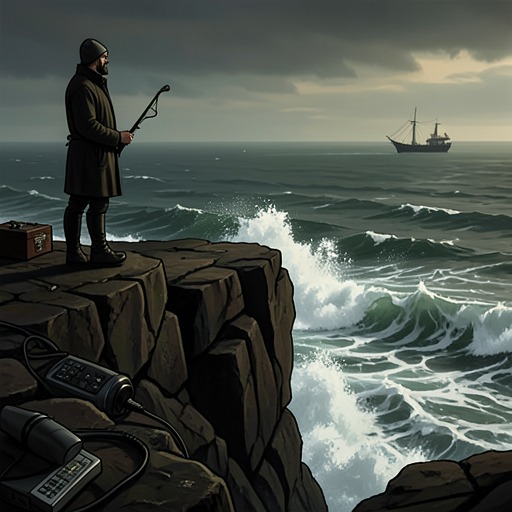
The expression first emerges from the narrator’s sense of frustrated potential. Alone on an airfield, he lies with his head on his parachute and struggles against the feeling that his hands cannot make what his imagination demands. He compares life to a block of marble awaiting a sculptor who could turn it into a masterpiece, while his spirit batters against its bounds. Looking toward the ocean, he recognizes a similar confinement beneath its apparent vastness: it seems to feign infinity, yet everywhere meets its limits. Its fury and roar become, in this comparison, not proof of limitless power but the sound of pressure contained.
That early image gives the later listening its tension. The narrator is not simply asking the sea to console him; he is drawn to it because its tumult resembles the frustration he knows from within. The ocean’s scale promises something beyond individual limits, but the narrator’s own perception insists that the sea, too, encounters boundaries. The image therefore offers no easy escape from constraint. Instead, it makes the ocean a counterpart: vast enough to suggest the infinite, yet close enough in its struggle to be called a brother.
The shore as a place of listening
Many years later, the narrator imagines himself lying among the rocks at Big Sur, listening to the ocean and trying to understand what it is telling him. The scene is presented as both a long vigil and an uncertain recollection: he says it seems to him that his fall happened there, and that he has been lying in that place for an eternity. The surf’s murmur becomes the sound around which this suspended sense of time gathers. The question is not answered by an event or revelation; the repeated effort to listen is itself the scene’s continuing action.
The setting is populated by precise signs of life. The beach is empty, yet the narrator sees Seals on a rock and thousands of seabirds on another; sometimes a whale spouts far offshore, while a Vulture circles lower above him. At dusk, the distant barking of the Seals reaches him across the sand. These animals do not translate the ocean or explain its meaning. Their presence instead alters what emptiness means: the shore may be physically unoccupied, but it is not, to the narrator, without company.
The listening also carries a history of attachment to vulnerable life. After the war, the narrator was so afraid of harming an ant that he could scarcely walk on the earth, or bear watching a bug drown. He later wrote a large book urging people to take the protection of nature into their own hands. He admits that he cannot say what he sees in the eyes of animals, only that their incomprehension recalls something that overwhelms him. Because he becomes attached easily and animals die quickly, he keeps none; he prefers to attach himself to the ocean, which does not die quickly. The contrast helps explain why the sea can serve as both beloved presence and enduring refuge without becoming a pet or a fully knowable companion.
An explanation withheld
At Big Sur, the narrator describes feeling almost on the point of breaking the code: the surf seems urgently to be offering a message, an explanation, a meaning, a key. Yet the language of imminence never resolves into a decoded answer. Even when he says the feeling of approaching understanding never quite leaves him, he disavows any expectation of a supernatural disclosure or reincarnation. The text sustains both claims at once: he no longer expects an explanation, but he continues to listen as though understanding might be near.
This tension gives the expression its open-ended force. The ocean’s message is not a doctrine that the narrator can pass on, nor a secret that the scene finally exposes. Its content remains withheld, while the act of listening recurs. The narrator can abandon the attempt and simply lie breathing; this rest is earned by having done all he could. Listening and stopping are not presented as contradictory conclusions. Both register the limits of what can be extracted from the world, and both leave room for the narrator’s remaining curiosity.
Companionship at the ending
In the closing scene, the narrator expects to leave the shore soon. Night will bring mist and cold, and he has never learned to light and keep a fire. Still, he tries to remain a little longer, with his eyes closed and a smile, listening for what the ocean may confide. The beach seems emptier and more densely peopled at once. He imagines one of the Seals swimming toward him and giving him a friendly nudge against his cheek or shoulder. The imagined gesture does not disclose the sea’s meaning; it gives the final act of listening a form of intimacy.
The narrator’s concluding sense that he has lived rests beside, rather than replaces, the unanswered message. The ocean has not yielded a key, and the scene does not claim that its murmur can be reduced to one lesson. Instead, the recurring expression gathers the book’s contrasts into a final posture: the wish to understand beside acceptance of limits, solitude beside felt company, and the desire for an explanation beside the simple continuance of breathing and listening. The shore offers no final proof, but it allows the narrator to remain attentive to a world that includes him without promising to explain itself.